Propane vs. Electric Patio Heaters: The Visionary Host’s Guide to 2026 Outdoor Warmth
The most expensive heater isn't always the warmest, and the sleekest design might leave your guests shivering in the December air. You've likely felt the frustration of an electric heater that barely cuts through a breeze or a bulky propane tank that interrupts the clean lines of your designer furniture. You deserve a curated outdoor environment that remains inviting even when the temperature drops below zero, not a cluttered space that feels like a construction site. Creating a true sanctuary requires a balance of raw power and aesthetic grace.
Deciding between a propane vs electric patio heater is about more than just fuel; it's about the architecture of your warmth and the intimacy of the guest experience. This guide provides the definitive comparison you need to transform your patio into a sophisticated, year-round retreat. We will explore how to achieve seamless integration with gazebos and pergolas while ensuring long-term durability through premium materials. You'll discover which technology powers a high-end hosting space and which one simply fades into the background, allowing you to host with absolute confidence regardless of the season.
Key Takeaways
- Learn how to curate a comfortable micro-climate by understanding the physics of radiant heat and its impact on open-air hosting.
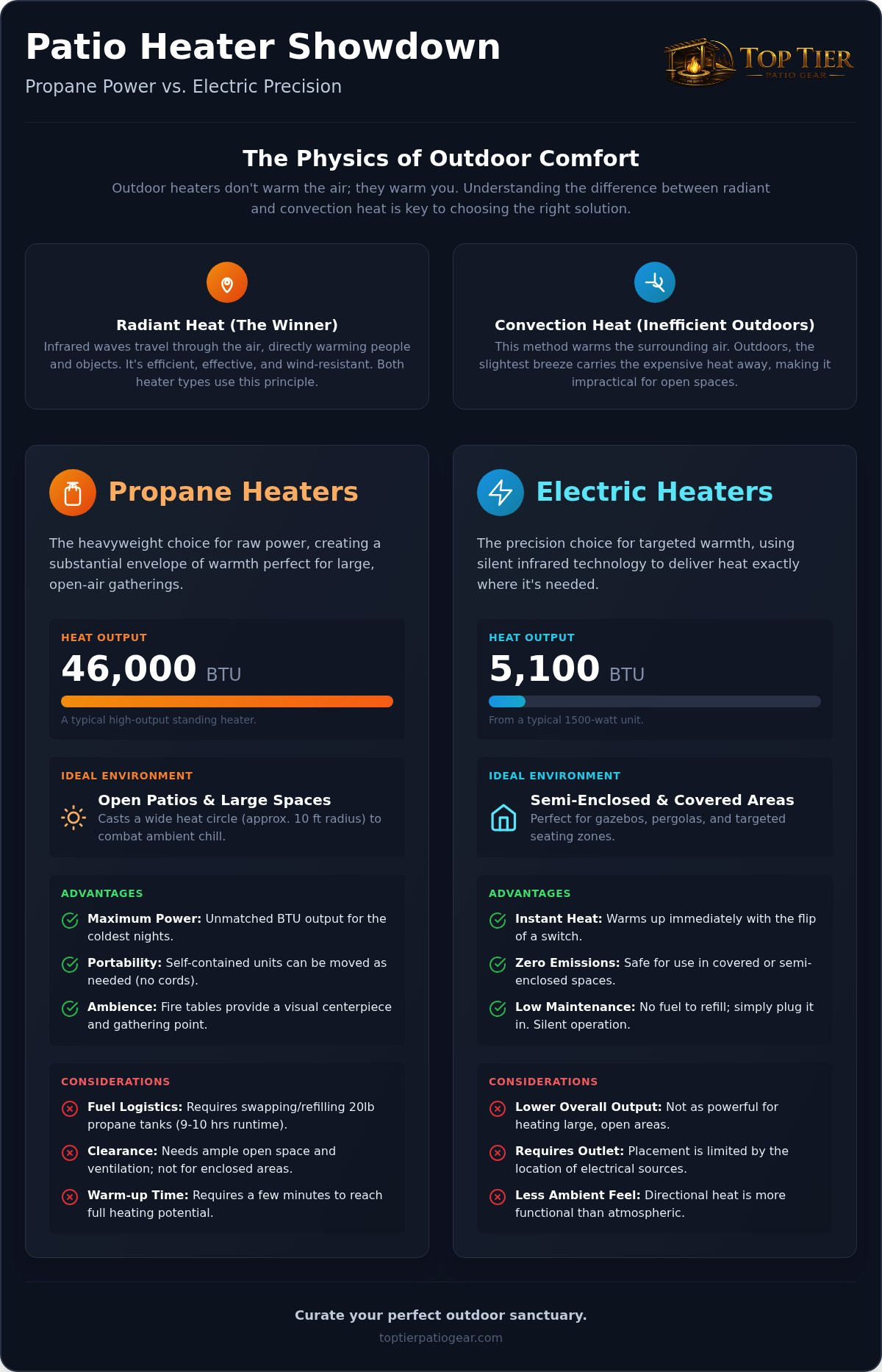
- Compare the high-output performance of 46,000 BTU units against the quiet, instant precision of modern infrared heating systems.
- Navigate the propane vs electric patio heater debate with a focus on your specific architectural needs, from open patios to enclosed gazebos.
- Simplify your operational logistics by identifying the fueling and electrical requirements necessary for a seamless, professional environment.
- Invest in permanence by selecting heating solutions crafted from premium materials that complement luxury furniture and withstand extreme winter weather.
The Physics of Al Fresco Comfort: Understanding Radiant Heat
True hospitality doesn't end at the threshold of your home. To the visionary host, a patio isn't just a space; it's a series of micro-climates designed for connection. Achieving this requires a shift in perspective. You aren't simply trying to warm the vast, open air. You're curating a specific sensory experience through physics. When weighing the choice of a propane vs electric patio heater, the most critical factor is how that heat travels from the source to your guests.
Radiant vs. Convection: Why It Matters
Traditional indoor heating relies on convection, which warms the air itself. Outdoors, this is a losing battle. The slightest breeze carries that expensive warmth away, leaving your guests cold despite the energy spent. Instead, a high-end radiant heating appliance uses infrared waves to transfer energy directly to people and furniture. This method is nearly 100% efficient at converting energy into warmth because it doesn't waste power heating the wind. While electric heaters excel at this direct transfer through silent, focused infrared waves, a high-output propane vs electric patio heater comparison often highlights the sheer volume of energy a gas unit provides. A 46,000 Btus Aluminum Propane Standing Patio Heater produces a significant heat envelope that can physically push back against a chilly draft, creating a robust "soft roar" of comfort that feels substantial.
Defining Your Heating Goal
Your choice depends on the atmosphere you wish to cultivate. Are you seeking an ambient mood for a late-night cocktail, or do you need survival warmth for a sub-zero dinner party? For many, the psychological impact of a visible flame is irreplaceable. A centerpiece like the Matteau Low 60 In. L X 12 In. H Outdoor Rectangular Concrete Composite Propane Fire Table provides both physical warmth and a mesmerizing visual anchor. However, in more sheltered spaces like the Alora Modern Outdoor Adjustable Pergola, the silent, consistent glow of a 50 Hz Portable Electric Outdoor Patio Space Heater might be more appropriate. Balancing heat intensity with guest proximity is an art. You want your guests to feel a gentle, enveloping warmth that encourages them to linger, rather than a harsh heat that forces them to retreat.
Propane Power vs. Electric Precision: A Technical Comparison
The choice between a propane vs electric patio heater is a strategic move for any visionary host. You must weigh the high-volume thermal output of gas against the refined, directional precision of electricity. A 46,000 Btus Aluminum Propane Standing Patio Heater serves as a true powerhouse, casting a wide heat envelope that covers a 10-foot radius. This is where raw energy meets social necessity, ensuring that even the furthest guest feels the embrace of your hospitality in an open-air setting.
The BTU Breakdown for Propane Enthusiasts
To understand the strength of propane, you have to look at the British Thermal Unit (BTU). A 46,000 BTU output is engineered to overcome significant ambient chill, making it the preferred choice for large, uncovered patios. However, this power requires logistical planning. A standard 20-pound propane tank provides roughly nine to ten hours of continuous warmth at a high setting. For those who want to blend this high-output heating with a sophisticated aesthetic, The Ultimate Propane Fire Table Guide explores how to integrate gas heating into your furniture layout. Regardless of the model you choose, always adhere to outdoor heating safety guidelines regarding clearance and ventilation to protect both your guests and your premium materials.
Electric Efficiency and Infrared Mastery
Electric heaters operate with a different kind of mastery. To bridge the technical gap for non-engineers, consider that a standard 1500-watt electric heater produces roughly 5,100 BTUs. While this seems modest compared to gas, the 50 Hz Portable Electric Outdoor Patio Space Heater uses infrared technology to deliver warmth with surgical accuracy. You'll enjoy instant heat the moment the switch is engaged, bypassing the warm-up period required by gas burners. This precision allows you to aim warmth like a spotlight, focusing on specific seating clusters without wasting energy on empty space. Because these units produce zero emissions, they're the superior choice for semi-enclosed sanctuaries like an Alora Pergola. If you're looking for a permanent, low-maintenance solution, a high-quality electric space heater offers the exact level of control a sophisticated environment demands.
Ultimately, your propane vs electric patio heater decision rests on the architecture of your space. Propane offers total freedom of movement, allowing you to reposition your heat source as the evening evolves. Electric models provide a steady, reliable glow that integrates flawlessly into fixed structures, offering a "set and forget" convenience that keeps the focus on your guests.
Operational Logistics: Installation, Fueling, and Maintenance
Ownership of premium heating is an exercise in stewardship. When you weigh the propane vs electric patio heater options, you're choosing between two distinct logistical lifestyles. One offers the freedom of a cordless powerhouse, while the other provides the effortless grace of a permanent utility. Both require a commitment to quality maintenance to ensure your sanctuary remains ready for guests at a moment's notice. True luxury is found in the reliability of your environment.
Propane Safety and Tank Management
For the visionary host, safety is the foundation of elegance. Propane management involves more than just swapping tanks; it requires a disciplined protocol of leak testing and secure storage. Using a simple soapy water solution on connections ensures your 46000 Btus Aluminum Propane Standing Patio Heater operates without incident. Modern design has evolved to make this process nearly invisible. For instance, the Matteau Low 60 In. L X 12 In. H Outdoor Rectangular Concrete Composite Propane Fire Table integrates hidden compartments that house the fuel source, preserving the clean lines of your furniture. If you're still deciding on the best format for your space, our Patio Heater vs. Fire Pit Comparison offers deeper insight into how these choices influence your layout.
Material Integrity and Weather Resistance
Longevity is a hallmark of a wise investment. While painted steel may appeal to the casual buyer, the sophisticated curator chooses aluminum or concrete composite for their permanence. Aluminum is the gold standard for coastal or high-moisture environments. It naturally resists the oxidation that destroys lesser metals. The 46000 Btus Aluminum Propane Standing Patio Heater is built to withstand salt air and heavy rain without losing its structural integrity. This material choice ensures your equipment looks as pristine in its third season as it did on the day of delivery.
Concrete composite fire features, like those in the Matteau series, offer a stone-like presence with enhanced durability. To prevent hairline cracks, ensure these surfaces are kept clear of standing water and treated with a breathable sealer once a year. Maintaining the internal mechanics is equally vital. Debris or small insects can occasionally obstruct burner ports, which diminishes your 46,000 BTU performance. A quick seasonal cleaning with compressed air keeps the flame consistent and powerful.
Electric units, such as the 50 Hz Portable Electric Outdoor Patio Space Heater, demand their own logistical attention. These heaters require dedicated circuits to handle the steady draw of power. Using a standard household outlet shared with other appliances often leads to tripped breakers during a party. Ensure your outdoor-rated outlets are professionally installed and GFCI-protected. This attention to detail ensures your heating remains as reliable as the structures it warms, allowing you to focus entirely on the connection with your guests.
Curating Your Sanctuary: Matching Heat to Architectural Structures
Architecture defines the boundaries of your comfort. When you introduce a heat source into a structured environment, you aren't just warming the air; you're engaging in a dialogue between materials and energy. A visionary host understands that a 12x20 Hardtop Gazebo with Metal Roof requires a different thermal strategy than a wide-open poolside deck. The debate between a propane vs electric patio heater often reaches its most critical point when considering these semi-enclosed structures. You must balance the raw power of gas with the spatial constraints and safety requirements of your chosen sanctuary.
Heating the Hardtop Gazebo
A 12x20 Hardtop Gazebo with Metal Roof acts as a natural thermal trap. The aluminum or steel ceiling reflects radiant waves back toward your seating area, significantly enhancing the efficiency of your heaters. If you opt for a 46000 Btus Aluminum Propane Standing Patio Heater, you must respect the vertical clearance requirements. These units need ample space between the burner and the roof to ensure safety and prevent material fatigue. For those utilizing wooden structures like the DIY Meridian 12 Ft. Octagon Enclosed Wood Outdoor Patio Gazebo, the 50 Hz Portable Electric Outdoor Patio Space Heater offers a safer, zero-emission alternative that eliminates the risk of trapped carbon monoxide. To understand more about how your structure influences your equipment choices, explore our Metal Gazebo Resilience Guide.
Flexible Solutions for Open Pergolas
Open structures like the Alora Modern Outdoor Adjustable Pergola with screens demand a more agile approach to warmth. Because wind can easily penetrate louvered roofs, positioning is everything. Whether you choose a propane vs electric patio heater, the goal is to create a warmth perimeter around your social hubs. Place your 46,000 BTU units upwind of your Nautica 7-piece rectangular outdoor patio aluminum dining table to allow the heat to drift naturally toward your guests. This creates a pocket of comfort that defies the evening chill.
For more intimate gatherings, low-profile solutions provide a sophisticated atmospheric centerpiece. The Matteau Low 60 In. L X 12 In. H Outdoor Rectangular Concrete Composite Propane Fire Table creates a fire-side zone that draws guests in. This low-profile heating is perfect for lounging in 8 Pieces Patio Furniture Sets with Swivel Rocking Chairs, as it warms the legs and torso directly. By matching the heat source to the architectural flow of your space, you ensure that every corner of your patio remains a usable, high-end sanctuary. If you're ready to complete your vision, browse our curated heating collection to find the perfect match for your gazebo or pergola.
The Sophisticated Choice: Investing in Long-Term Outdoor Value
Investing in your outdoor space is a commitment to your lifestyle and the connections you foster within it. Your choice between a propane vs electric patio heater is the final brushstroke in a masterpiece of residential design. It isn't merely about temperature; it's about the intentionality of your environment. By selecting high-end equipment, you're ensuring that your sanctuary remains a place of comfort and elegance for years to come. True value lies in the intersection of performance and permanence.
The Propane Powerhouse: For the Grand Event
When your social calendar is filled with expansive gatherings, you need a heat source that commands the space. The 46000 Btus Aluminum Propane Standing Patio Heater is the quintessential choice for open-air hosting. Its massive thermal output creates a robust micro-climate that allows your guests to move freely across your deck or lawn without losing the embrace of warmth. For a more grounded social anchor, the Matteau Low 60 In. L X 12 In. H Outdoor Rectangular Concrete Composite Propane Fire Table offers a sophisticated focal point. It combines the raw energy of gas with the timeless durability of concrete, creating a hearth that naturally draws people together. These units are built for the visionary host who refuses to let the winter limit the scale of their hospitality.
The Electric Specialist: For the Intimate Retreat
For the quieter moments that define high-end living, the precision of electricity is unmatched. The 50 Hz Portable Electric Outdoor Patio Space Heater is the specialist's tool. It's ideal for those focused, intimate scenarios like a morning coffee in a hardtop gazebo or a late-night reading session. This technology integrates seamlessly into the Alora Modern Outdoor Adjustable Pergola, providing a silent and steady glow that doesn't disrupt the tranquility of the night. Because electric heat is directional, you can curate specific "warmth zones" without the need for ventilation, making it the superior choice for semi-enclosed architectural structures. It offers a level of refined control that matches the sophisticated pace of your personal relaxation.
Ultimately, a curated heating strategy is an investment in your home's legacy. Choosing premium materials like aluminum and concrete composite ensures that your equipment resists the elements and retains its beauty. This attention to detail increases both your property value and your daily quality of life. Envision the memories yet to be made; the deep conversations and shared laughter that only happen when the environment is perfectly tuned. By resolving the propane vs electric patio heater debate with a focus on quality, you're building a year-round sanctuary where the warmth is as enduring as the craftsmanship.
Curate Your Year-Round Sanctuary
Your outdoor environment is a canvas for connection. It's where the finest memories are forged. By matching your heating technology to the unique architecture of your home, you've secured the ability to host with confidence regardless of the season. Whether you prioritize the raw power of gas for an open-air gala or the silent precision of electricity for an intimate retreat, your choice reflects a commitment to excellence. Creating a true micro-climate is the ultimate gift to your guests.
The final decision between a propane vs electric patio heater is about more than utility; it's about the permanence of your sanctuary. Selecting premium aluminum and concrete composite construction ensures your investment remains a centerpiece of your home for years. You shouldn't have to choose between aesthetic grace and functional strength. High-end materials provide the durability required for sub-zero temperatures while maintaining a sophisticated look that complements your luxury furniture.
Explore the Top Tier Patio Gear Collection of Premium Heaters to discover 46,000 BTU high-output performance and professional-grade durability. With free national shipping on all premium gear, there's never been a better time to refine your outdoor living. Your sanctuary is ready for its next chapter, and we're here to help you light the way.
Frequently Asked Questions
Can I use a propane patio heater under a hardtop gazebo?
Yes, you can safely use a propane heater provided you maintain strict clearance requirements. A 12x20 Hardtop Gazebo with Metal Roof can house a 46000 Btus Aluminum Propane Standing Patio Heater if there is at least 3 feet of clearance from the top and sides. Ventilation is essential to prevent heat buildup and carbon monoxide accumulation. Always check your specific manual for vertical clearance to protect the metal roof's integrity.
Do electric patio heaters actually work in cold, windy conditions?
Electric infrared heaters are exceptionally effective in windy conditions because they heat objects directly rather than the air. While a propane vs electric patio heater comparison often favors propane for raw power, electric models like the 50 Hz Portable Electric Outdoor Patio Space Heater use radiant energy that wind cannot blow away. This makes them ideal for open pergolas where cross-breezes would otherwise strip away convective heat from gas units.
How many BTUs do I need to heat a 20x20 patio space?
A 400 square foot space generally requires approximately 40,000 to 50,000 BTUs for effective coverage in moderate chill. A single 46000 Btus Aluminum Propane Standing Patio Heater is often sufficient for a centralized seating area within that footprint. If the patio is fully open and the temperature is sub-zero, you might consider pairing a standing heater with a Matteau Low 60 In. L X 12 In. H Outdoor Rectangular Concrete Composite Propane Fire Table.
Is it cheaper to run an electric patio heater or a propane one?
Electric heaters are typically more cost-effective over the long term due to their high efficiency and lower fuel costs. Based on current 2026 data, a 1500W electric heater costs approximately $0.26 per hour to operate. In contrast, a 40,000 BTU propane heater costs about $2.00 to $2.20 per hour. While the initial investment in a propane vs electric patio heater varies, the daily operational savings of electricity are significant for frequent hosts.
What is the life expectancy of an aluminum patio heater vs. steel?
Aluminum heaters significantly outlast painted or powder-coated steel models, especially in coastal environments. Aluminum naturally resists rust and corrosion, often providing ten or more years of reliable service with minimal maintenance. Steel units are prone to oxidation once the finish is chipped or scratched, which can lead to structural failure within three to five years. Choosing a 46000 Btus Aluminum Propane Standing Patio Heater ensures long-term durability and aesthetic permanence.
Are portable electric heaters safe to leave outside in the rain?
You should not leave portable electric heaters exposed to direct rain unless they carry a specific high-level IP rating for wet locations. Most units, including the 50 Hz Portable Electric Outdoor Patio Space Heater, are designed for damp environments but should be sheltered under a structure like an Alora Pergola or a hardtop gazebo. Always unplug the unit and store it in a dry area when it isn't in use to protect the electrical components.
Do I need a professional to install my outdoor heating system?
Portable propane units and plug-in electric heaters don't require professional installation. You can set up a 46000 Btus Aluminum Propane Standing Patio Heater yourself by following the assembly instructions. However, if you choose a mounted electric heater that requires a dedicated 240V circuit, you'll need a licensed electrician. Top Tier Patio Gear focuses on high-quality equipment sales; we don't provide installation services, so check with local contractors for hard-wired projects.
How do I calculate the 'warmth zone' for my patio furniture set?
To calculate the warmth zone, identify the effective radius of your heater, which is usually 8 to 10 feet for a high-output unit. Place your Nautica 7-piece rectangular outdoor patio aluminum dining table or 8 Pieces Patio Furniture Sets with Swivel Rocking Chairs within this circle. For a 46,000 BTU heater, the most intense heat is within 5 feet. Position the heater upwind of the seating area so the radiant waves reach your guests naturally.